

Editor’s note This is a complete English translation of the published Chinese article, with publication chrome, image captions and account notices omitted. Facts, estimates and framing reflect the original publication date. The original Chinese article was published under Han Hao’s pen name, Chen Changdao. The Chinese original remains available through the source link below.
Summary
At the invitation of Russian President Putin, from 12 to 17 September local time, the Secretary-General of the Korean Labour Party, Councillor Kim Jong-un, made a State visit to Russia and met with Putin. This was the first visit to Kim Jong-un since the outbreak and another visit to Russia after four years. Following his meeting, Putin was pleased to accept an invitation to visit the Democratic People ' s Republic of Korea, where both sides set a high profile in their press briefings for the visit and displayed strategic cooperation between the two countries. The deepening of bilateral relations between Russia and the Russian Federation will have a profound impact on the conflict between Russia and Ukraine and the situation on the peninsula, accelerating the process of restructuring the global geomorphology.
The first visit since the outbreak has led to a high level of bilateral interest.
This visit to Russia was the tenth of its kind and the longest since his appointment. In addition to the length of time, the wealth of the trip and the examination of the site of the visit also reflect the importance attached to the visit by the two countries at a high level. According to The New York Times, the two sides have been preparing for this visit for several months, and during their visit to the Democratic People ' s Republic of Korea in July, the two sides had exchanged views of the heads of State. Subsequently, in late August, a delegation of approximately 20 people visited Vladivostok and Moscow. It is believed that the delegation included officials responsible for the security of the highest leadership, which was widely perceived as a signal from Kim Jong-un to Russia. The day before their arrival in Kim Jong-un, both sides officially announced their visit to Russia.
Similar to the last visit to Russia, all the trips to Kim Jong-eun were concentrated in the Russian Far East, which is easily accessible by train, and the choice of the place to visit clearly reveals the direction of possible cooperation between the two countries. Comprehensive Tas reported that during the six-day journey Kim Jong-un visited the Orient Space Launch site, the Green City on the Amur River and Vladivostok. According to the Russian side, the trip included not only official meetings with senior officials and visits to important industrial facilities, but also activities such as aquarium visits and ballet visits to “in-depth experience of Russian society”.
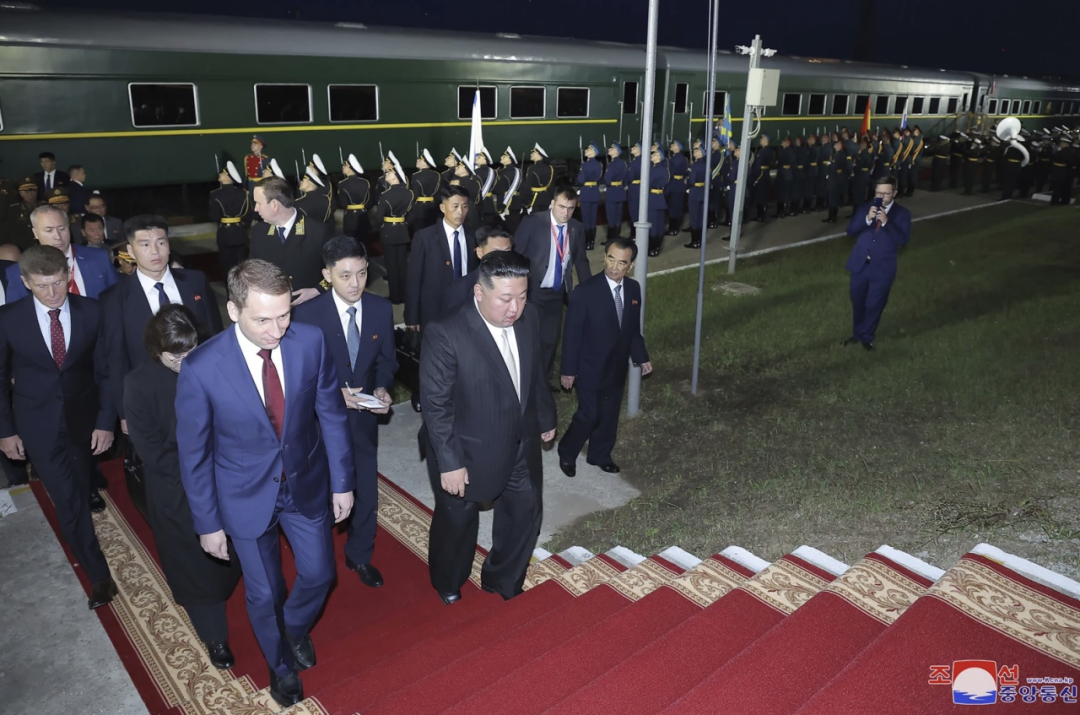
Since arriving in Russia, Kim Jong-un has been subjected to a very high degree of courtesy. According to KCN, Kim Jong-un left Pyongyang on 10 September in a special column and entered Russia from the border city of Hassan on 12 September, where he was greeted by high-profile Russian officials. The Russian Minister of Natural Resources and Ecology, Alexander Kozlov, and the Governor of the Maritime Territory, Oleg Kojemiko, both central and local officials, conveyed Putin’s greetings to Kim Jong-un at the station and invited Kim Jong-un to watch the battle. Russian officials praised Kim Jong-un as “the closest friend of the Russian people” and stated that they would “done to the best of intentions” during the visit. After completing the ceremony in the early morning of 12 December, Kim Jong-un arrived at the Orient Space Launch site the following afternoon, received another high-profile reception from the Russian side and officially opened a meeting between the two heads of State.
According to Tas, after a 40-second handshake after a meeting between the two heads of State, joint visits were made to the Orient Space Launch site. Following the visit, the two delegations held “one-on-one” meetings for five hours. After dinner with the two parties, Kim concluded his official trip to Russia for the first day. The press secretary of the President of the Russian Federation stated that the meeting of the heads of State of the two sides was “only one day and is over”. It was generally noted that no agreement had been signed between the two parties since the meeting, that no joint press conference had been held and that the Russian side had made public only one of the two persons ' conversations at an informal meeting.
Citing a professor at the King ' s College in London, the National Assembly Hills said that the failure to publish a formal agreement did not mean that there was no agreement between the two countries, and that such an arrangement was more likely to avoid external challenges, given that the Security Council had maintained a tight regime of sanctions against the DPRK since resolution 1718 (2006). Accordingly, from the close interaction of the leaders of the two countries and from the staffing of accompanying officials, some of the United States media initially speculated that high-level contacts between the Democratic People ' s Republic of Korea and the Russian Federation during five hours of meetings could be effective in terms of space cooperation, defence cooperation and food aid.
In the context of the open dialogue, which coincided with the celebration of the 75th anniversary of the founding of the DPRK, the Head of State of the DPRK and the Russian Federation first reviewed the history of the development of bilateral relations. In his statement, Putin stated: “My country was the first to recognize the sovereignty and independence of the Democratic People's Republic of Korea. This is a landmark day because we helped friends to preserve independence and sovereignty.” In response, Kim Jong-un stated that “the Soviet Union played an important role in liberating and assisting our country's independence, and our friendship was deeply rooted”.
Kim Jong-un immediately stated that North Korea's relations with the Russian Federation were “the top priority of our country” and that he would “continue to support every decision taken by President Putin, as well as that of the Russian Government”. KCNA reported that the meeting between the leaders of the two countries was “historic” and “strategic” and that it was “an opportunity to promote traditional relations of friendship and cooperation and good-neighbourly relations between Russia and Russia and to further develop to a new height”.
The U.S. is worried about Russian space cooperation.
The venue of Kim Jong-un ' s visit to Russia has chosen to convey more directly the possibility of enhanced cooperation between the two countries in space and defence than the symbolic summit meeting. In the view of the United States, the trip of Kim Jong-un will raise two concerns on both sides of the continent: In the west, North Korea ' s conventional weapons can be used to resupply Russian troops on the Russia–Ukraine front; in the east, Russian technical assistance will enhance North Korea ' s strategic surveillance capabilities, and will even constitute a stronger nuclear deterrent to the United States and its allies in space and underwater.
As the first stop of Kim Jong-un ' s visit to Russia, the meeting at the space base was undoubtedly a clear trend towards increased cooperation between the two countries in the space field. Unlike previously anticipated by the United States, the two heads of State did not choose to meet after the Eastern Economic Forum in Vladivostok, but instead chose the relatively remote Eastern space launch site. The launch site, which is located at 51° N and carried out its first launch mission in 2016, is the only space launch base in the Russian Far East. In 2007, Putin himself signed a presidential decree establishing the base, aimed at reducing Russia ' s dependence on the Kazakhstan Baikonur space base. In April 2022, Putin also received President Lukashenka of Belarus here. In its coverage, CNN called the base “the pet of Putin” and believes that the holding of the meeting here demonstrates the importance Putin attaches to his guests.
Tas reported that, prior to the formal talks, Putin accompanied Kim Jong-un to the two launch towers at the Eastern Space Launch Site and to the assembly workshop of the “Angara” heavy launch vehicle. Putin stated to journalists that the DPRK is working to develop its space industry, that Kim Jong-un “has shown great interest in missile technology” and that Russia already has “good power” in this regard. When asked if Russia would help North Korea develop its space industry, Putin said, “That is why we came to the Orient Space Launcher”.
Although the launch missions carried out so far at the Orient Space Station have been primarily of a civilian nature, the United States and its allies are extremely wary of the possible military implications of cooperation with the Democratic People ' s Republic of Korea, as the launch vehicles can also be used for military purposes such as launching reconnaissance satellites and developing intercontinental ballistic missiles. The Associated Press reported that the Democratic People ' s Republic of Korea had launched two spy satellites in May and August of this year, which had failed. The report quoted a Korean military expert as saying that the Democratic People ' s Republic of Korea might not only assist Russia directly in launching the satellite but rather try to participate as much as possible in the complete process of satellite manufacturing and launch and to obtain technology transfer.
While Kim Jong-un was meeting Putin, CNN quoted news from the Korean side that the DPRK had launched two short-range ballistic missiles into the eastern sea. This was the first time that the DPRK had launched a ballistic missile when the top leader was not at home. Reports indicate that since the beginning of 2022, the Democratic People ' s Republic of Korea has carried out more than 100 missile launches, creating continuing pressure on both countries. A researcher at the Korea Defense Analysis Institute stated that since the Soviet Union began supplying the DPRK with SA-2 surface-to-air missiles, missile cooperation between the DPRK and Russia has never ceased, and Putin ' s statement this time is no doubt a redefinition.
Unlike before, however, the United States and its allies are increasingly concerned about the country's access to reliable sea-based nuclear forces, following the high-profile announcement earlier this month of its first “tactical nuclear attack submarine”. According to The New York Times, this “tactical nuclear attack submarine” is not a nuclear-powered submarine in the general sense, but rather a “conventional-powered submarine capable of carrying a nuclear warhead missile”. Although the vessel was not capable of carrying strategic ballistic missiles that could pose a threat to the United States, it was likely to carry short-range ballistic missiles and cruise missiles with ranges covering Japan and Korea, as inferred from the volume of discharges and the vertical size of missile silos. Given that the DPRK has successfully tested submarine-launched ballistic missiles and long-range cruise missiles, the vessel could pose a greater threat to the United States military presence and its allies in the Asia-Pacific region.
In response, his Government's current response remained focused on maintaining the Security Council resolution on sanctions against the Democratic People's Republic of Korea. In response to questions on 13 September, Matthew Miller, the spokesman for the United States Department of State, said that Russia's contribution to the development of satellite technology would speed up the ballistic missile development process in North Korea, which was “very disturbing and could violate numerous United Nations Security Council resolutions, which Russia itself had voted in favour. The United States warns that it will “act without hesitation when necessary to hold these people accountable”. He also condemned the 12-day missile launch by the Democratic People's Republic of Korea, which was “the latest in a series of launches posing a direct threat to neighbouring countries”, undermining regional security, and reaffirmed the United States' “strong commitment” to protecting Japan and Korea.
Potential arms trade or its impact on the situation in Ukraine
In addition to possible space cooperation, the high level of defence traffic between the Democratic People ' s Republic of Korea and the Democratic People ' s Republic of Korea has raised concerns about possible arms trade between Russia and the Democratic People ' s Republic of Korea, leading to a change in the balance of forces on the Russian-Ukrainian front. The possible arms trade between the DPRK and Russia will be two-way in terms of the demand structure. On the one hand, the relatively weak Korean People ' s Army Navy and Air Force urgently need new equipment. According to NBC News, of the three stations in Kim Jong-un, the remaining two were important military industries in the Russian Far East. The Chongqing City on the Amur River has been a major military-industrial town since the 1930s, where Russia ' s largest aircraft manufacturing plant, the Gagarin aircraft manufacturing plant, is located, producing not only the world ' s best-selling fighter jets, such as Su-27 and Su-30, but also the most advanced SUV fighter aircraft today.
According to KCNA, during a visit to the city on 15 September, Kim Jong-un visited not only the fighter jets, passenger and general assembly workshops at the Gagarin aircraft manufacturing plant, but also personally boarded the cabins of the Su-57 fighter aircraft and heard the Russian side ' s presentation on the characteristics and performance of this fifth-generation fighter. The Russian side has also arranged a pilot flight demonstration for the Su-35 fighter jet in Kim Jong-un. According to the Foreign Policy Review, despite the current technical level of the Korean Air Force, these advanced fighter jets remain inaccessible. However, even if the Democratic People ' s Republic of Korea did not procure new fighter jets, it would be possible to obtain a stable supply of spare parts and parts from the Russian side and to improve the adequacy of the existing Soviet fleet to enable it to conduct more high-frequency missions.
Kim Jong-un's last stop was in Vladivostok, the Russian Pacific Fleet site, where Putin and Kim Jong-un met in 2019. Kim Jong-un met here with the Russian Defence Minister, Shoyugu, and accompanied the latter by a tour of the Tu-95, Tu-160 and Tu-22 strategic bombers, which formed the main strategic strike force of the Russian Air Force and were visible in the Russia–Ukraine conflict. During the visit, the Russian side also showed the outside world for the first time a new long-range missile equipped with a Tu-160 strategic bomber with a range of over 6,000 kilometres. In addition, Kim Jong-un, accompanied by the Commander-in-Chief of the Russian Navy, visited the Pacific fleet's large anti-submarine type 1155, "Major Saposhnikov", which was built in the 1980s as one of the few large Pacific fleets that had been modernized in previous years.
The United States is most concerned about the possible supply of arms and ammunition to Russia by the Democratic People ' s Republic of Korea in comparison with the long-cycle acquisition of naval and air force equipment, which may change the balance of power on the Russian-Ukrainian front in a short period of time. During the nineteenth month of the conflict, the front remained deadlocked and the parties were temporarily unable to launch a strategic offensive. In the absence of air forces on both sides to control the war, artillery has become a significant force, and the Los Angeles Times reported in July this year that about 80 per cent of the casualties from the Russia–Ukraine conflict were caused by artillery. NBC News quoted David Silbey, a military historian at Cornell University, as saying that the conflict had turned into an âartillery duelâ, with Russia consuming about 20,000 shells a day, while Ukraine consuming 5,000 rounds a day. As the ammunition stocks of both sides bottom, the frequency of artillery fire has been significantly reduced.
Previously, in order to ensure the supply of Ukraine ' s artillery, the United States had consumed a large stock of its own and its allies and had even begun to restart production lines; the same supply pressure had appeared on the Russian side. As early as December last year, media such as the NBC reported that the Russian Army was having to activate ammunition produced 40 years ago because of lack of artillery shells, and that 50 per cent of those munitions were unusable owing to years of poor storage. Under the circumstances, thanks to the fact that the Korean People ' s Army is equipped with a large number of guns of the same calibre as the Russian army, if an agreement is reached with the DPRK, the Russian army can quickly obtain ammunition, in particular for the immediate shortage of 152 mm and 122 mm shells on the front line.
Last September, The New York Times reported that the Wagna Group had purchased arms and ammunition from Korea. In response, KCNA issued a statement by a North Korean official stating that the Democratic People ' s Republic of Korea had never intended to export arms and ammunition to Russia. However, as the situation evolved, the United States-led countries noted the interaction at the top of the military hierarchy in the Democratic People ' s Republic of Korea and began to cast doubt on that commitment.
In July this year, the Russian Defense Minister, Shoyugu, visited the DPRK, became the first Russian (USSR) commander in history to visit the DPRK and was invited to the Korean Victory Day parade. The United States suspects that the export of artillery shells and other arms has been under discussion between the two sides, at least since the visit. At a press conference in August, the Strategic Communications Coordinator of the United States National Security Council stated that “the two sides of the Democratic People's Republic of Korea are working on a possible agreement under which Russia will acquire large quantities of ammunition from the Democratic People's Republic of Korea, which the Russian military plans to use in Ukraine... We urge the Democratic People's Republic of Korea to stop negotiating weapons with Russia and to abide by its prior public commitment not to supply or sell weapons production”.
The spokesman for the Department of State, Matthew Miller, also stated at a press conference the day before Kim Jong-un's visit to Russia that the United States would closely monitor the progress of the two heads of State's meetings and “continue to hold accountable the entities that helped Russia's military operations in Ukraine”. He said, “I remind the two countries that any arms shipment from North Korea to Russia would violate many United Nations Security Council resolutions... Of course, we have imposed sanctions on entities that support Russia's acts of war, and we will continue to implement them and will not hesitate to impose new sanctions as appropriate.” On 17 September, Vice-President Harris, in an interview with the CBC, also stated that an arms agreement between the heads of the Democratic Republic of the Congo and the Russian Federation would be a huge mistake and would further isolate them.
Despite the fact that the Heads of State of the Democratic People ' s Republic of Korea and the Russian Federation have suggested possible military cooperation on many occasions, neither side has formally expressed or signed any kind of agreement because of the excessive involvement of the Democratic People ' s Republic of Korea in the arms trade, which not only constitutes a serious violation of numerous Security Council resolutions, but also has the potential to significantly disturb the situation on both sides of the continent. After concluding his dialogue with Kim Jong-un, when asked whether the Democratic People's Republic of Korea would engage in military cooperation, Putin said to journalists: “There are restrictions (in this field) which Russia is following. Russia is a self-sufficient country, but there are certain matters that we can take note of and which we are discussing.” Two days later, Putin reiterated that Russia had no intention of violating Security Council resolutions on sanctions against the Democratic People ' s Republic of Korea, but would still seek new opportunities to develop Russian-Korean relations.
Given the low level of substantive public results of the trip, and the fact that the impact of the follow-up is still to be seen over time, the United States response to Kim Jong-un’s visit to Russia is still fragmented, but it seems that the United States toolbox for dealing with the Democratic People’s Republic of Korea seems to be left with the “sanctions” option. It also triggered discussions on the foreign policy of the Biden Government. The BBC quoted Rorry Daniels, Executive Director of the Asia Association Institute of Policy Studies, as saying that the effect of the frequent use of sanctions by the United States was questionable, “the more severe sanctions are imposed, the less the United States is able to use them as a bargaining chip to resolve potential conflicts”. The irresponsible behaviour of the United States in recent years has also increased tensions on the peninsula, leaving the process of the denuclearization of the peninsula in abeyance and unilateral sanctions preventing a consultative dialogue between the parties. A comment published in Foreign Policy states that, even from the most realistic point of view, if the United States is to establish a pragmatic policy against the Democratic People's Republic of Korea, “it should start by putting an end to the seemingly hostile policies”.
Read the complete article in its original context.
Fudan Center for China–U.S. Cooperation · September 20, 2023 · Chinese
Open the original Chinese article