

Editor’s note This is a complete English translation of the published Chinese article, with publication chrome, image captions and account notices omitted. Facts, estimates and framing reflect the original publication date. The original Chinese article was published under Han Hao’s pen name, Chen Changdao. The Chinese original remains available through the source link below.
Summary
A month has passed since the outbreak of a new round of Israeli-Palestinian conflict. The conflict escalated again after Israeli ground forces entered Gaza on 27 October. According to Al Jazeera, the armed conflict, which lasted for almost a month, has resulted in some 60,000 casualties on both sides, of which more than 10,000 have unfortunately been killed; the power and water outages have made it difficult to maintain the most basic civilian facilities in the Gaza Strip, and the humanitarian crisis continues. Despite Biden's attempts to bind the Palestinian-Israeli conflict and the Russian-Ukrainian conflict on various occasions, In the same narrative, the vision of the “democratic alliance” continues to be sold out. However, with the intensification of the conflict, this unstinting power of Israel has been increasingly called into question, as has the division of American society.
The Israeli ground attack on Gaza escalated again
Unlike “surgery” operations, which focus mainly on air strikes and remote strikes, ground force advances aimed at achieving full control of an area often have strong political significance. Clearly, at a time when internal and external challenges are unfolding, the United States and its allies are not prepared to respond to the full escalation of the Israeli-Palestinian conflict and are trying to persuade Netanyahu to postpone its ground offensive against Gaza.
The New York Times quoted informed sources on 22 October that Biden, through Defence Minister Austin, had conveyed a message to Israel recommending that it suspend its ground offensive against Gaza, buy time for the operation of multiple American lines and avoid falling into direct conflict with Iran and its allies. On the diplomatic side, the United States wants more time to negotiate the release of hostages, and Hamas, through Qatar, has made it clear that ground incursions will significantly reduce the likelihood of their release; that military deployments will require the United States forces to be prepared to respond to possible attacks by Hamas and its allies; and that Biden would like to seek more batches of humanitarian aid into Gaza in an attempt to supplement his widely questioned Palestinian-Israeli policy in public opinion.
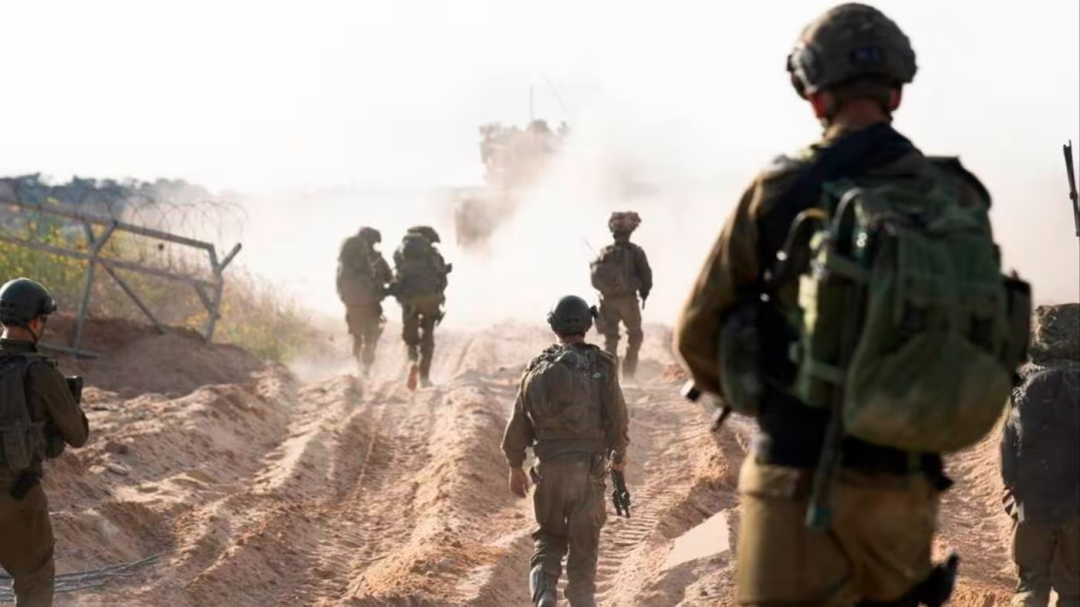
Israeli soldiers entered the Gaza Strip.
The Israeli Times quoted several Israeli Ministry of Defence officials as saying that the Israeli ground offensive had indeed been delayed for several days to facilitate negotiations on the release of hostages, but it had never been stopped directly by the United States, and Biden had supported Israel's “total destruction of Hamas”. As Ambassador Michael Herzog said in an interview with CNN, “There is no pressure on us, they advise us, but not what we should and should not do.”
It is clear that the hesitation of the United States side will not be an obstacle to an Israeli ground offensive. On the night of 27 October, Israeli armoured forces entered the Gaza Strip in secret and began a large-scale ground offensive. The operation was highly confidential and, six hours after the attack began, the Israeli army admitted to having “entered Gaza”; and 24 hours later Netanyahu officially declared the war “entering phase II”, indicating that the ground offensive was planned to save hostages and completely destroy Hamas. It is generally accepted that, unlike several “correctional” attacks on the ground since the twenty-first century, they have become larger in scale and the purpose of “destruction” and even “control” has become clearer. Reuters quoted an engineer commander who had been involved in the operation in 2014 as saying that in 2014 they had been instructed “to enter a tunnel no more than two kilometres”, and this time to destroy Hamas' “real underground fortress”.
The Israeli forces concentrated the attack in the northern part of Gaza City, directly pointing to the Hamas command centre. According to the Financial Times, the Israeli ground forces split three routes, moving from the northern border near Gaza City to the south of the coast, covering its flanks from the north-east border, and moving westward from the central border to the coast, cutting the entire Gaza Strip to the north and south in an attempt to cut Gaza City off from the rest of the country. Almost a week after the ground offensive began, Israeli forces claimed to have completed the siege of Gaza City on 2 November. As of the time of writing, the parties had not been caught in an alley war.
The blue part of the pattern of attacks by Israeli ground forces represents the area of control claimed by the Israeli forces.
Contrary to general speculation, the Israeli army, which has concentrated a large number of armoured units, has not launched a “blitz war” and the forces on all three fronts are advancing towards Gaza City at a cautious pace, so that it took just hundreds of kilometres to arrive almost a week. Accordingly, Israeli forces were well prepared before launching the ground offensive, which was launched on the afternoon of the day when Israel blocked communications and network signals throughout Gaza, paralysed communications throughout the region and carried out a full bombing of northern Gaza. It was only after the fire had been prepared that the ground forces launched an attack led by armoured units. The following engineers were able to raze or blow up the tunnel along the road and move slowly forward with a step-by-step posture.
There are two main and objective reasons behind the perverse pace of the Israeli offensive. Subjectively, the New York Times analyses that through Gaza City, Israel has maintained a strategic ambiguity over Hamas and has taken the lead in the war; on the other hand, Israel has continued to explore the response of Hamas and its allies as the front slowly advances, avoiding possible retaliation in other directions. Finally, Reuters commented that the Israeli side still hopes to preserve the two ways of resolving the hostage issue, and does not wish to close the door to negotiations with a quick attack.
Objectively, the slow pace of the attack could more completely remove the ability of Hamas to launch a military attack. Al-Jazeera reported that on 3 November, the daily number of rockets fired by Hamas into Israel had dropped from dozens before the ground attack to nine; the Israeli army also hoped that it would be able to attract the living forces of Hamas out of the buildings and tunnels, thereby taking advantage of its own technology. In addition, heavy fighting in the alleys, which will inevitably result in heavy casualties for both armies and the civilian population of Gaza, is not appropriate for the Israel Defense Forces, which just a month ago experienced heavy casualties, and the humanitarian catastrophe caused by the alleys is beyond military control as global public opinion grows to question the almost indiscriminate use of force.
Gaza City after Israeli bombing.
As at 4 November, Israel seemed to have completed its first battle target for that phase, achieved a “no siege” of Gaza City and, to some extent, weakened Hamas's military capability in the northern Gaza Strip, but the achievement of the strategic objectives was far from complete. Taking into account the historical performance of the Israeli army, the level of its presence in this round of conflict is significantly lower than expected from outside. Al Jazeera quoted a United States military officer as saying that the Israeli army had suffered too much since 7 October, which was embarrassing for an army that had placed a strong emphasis on avoiding casualties while preparing for war. Even during its active ground offensive phase, the Israeli announcement of its own casualties was close to 300.
At the same time, Hamas has long operated in northern Gaza, relying on its complex tunnel system and its military capacity remains impeccable. Al-Jazeera reported that even days after the ground attack, the Hamas Qassam Brigade entered Israel through tunnels in the north, attacking Israeli armoured units from the rear, and that the Brigade indicated that rockets would be targeted at Israeli nuclear facilities in the Negev. An Italian scholar also stated in an interview that Hamas had been able to launch 6,000 rockets into Israel in one breath, indicating that Hamas had unprecedented military capabilities. By definition, even at the military level, the goal of Netanyahu's “destruction of Hamas” is far from being achieved.
The humanitarian crisis is fertilizing and differences between Israel and its allies arise
The conflict since 7 October has brought with it a huge humanitarian catastrophe, which is bound to be exacerbated by Israeli ground attacks. According to the United Nations Office for the Coordination of Humanitarian Affairs, 298 people, including 125 children, died within 24 hours of the start of the Israeli ground offensive. According to the Palestinian health sector, Israeli air strikes on Jabaliya refugee camp in northern Gaza on 31 October and 1 November resulted in nearly 200 deaths and injuries. The Israeli military argued that the attack was aimed at targeting Hamas commanders who had assisted in the planning of the attack on 7 October. On 3 November, an ambulance team came under Israeli air strikes in front of Al Shifa Hospital in Gaza City, killing at least 15 people and injuring 60 others. The Israeli forces subsequently indicated that they had attacked an “ambulance used by a Hamas terrorist organization”, adding that “a number of Hamas terrorists were killed in the attack”.
Ambulance team attacked by Israel on 3 November.
In addition to direct physical injury, the Israeli-led offensive also exacerbated the shortage of resources and services. On 1 November, the day before Israel announced the completion of the siege of Gaza City, the only hospital in Gaza that had access to cancer treatment, the Turkish-Palestinian Friendship Hospital, was declared closed. According to Al Jazeera, 16 of the 35 hospitals in the Gaza Strip are now out of operation and more than 50 of the 72 primary clinics have been closed in the absence of electricity and necessary supplies. In a press briefing, the United Nations Office for the Coordination of Humanitarian Affairs indicated that none of the aid convoys currently authorized to enter the Gaza Strip contained fuel for hospital electricity. It also noted that, as a result of Israeli ground operations in northern Gaza, links between the northern part of Gaza City and other areas were largely cut off, directly resulting in the exclusion from humanitarian access of some 300,000 displaced persons in the north.
The New York Times reported that when asked about deaths and injuries in Gaza, Netanyahu said that “no civilian should die”, and accused Hamas of “stopping civilians from the conflict zone”. Previously, Israel had demanded that the more than 1 million inhabitants living in northern Gaza should be evacuated in full within 24 hours to avoid being mistakenly wounded by the attack.
Doctors and patients in a hospital in Gaza.
Like any issue with a complex history of latitude, the Palestinian-Israeli problem cannot be resolved by purely military means, but on the contrary, over-reliance on aggressive military means can have unintended political implications. While Western allies, led by the United States, maintain their support for Israeli military operations, as the humanitarian catastrophe caused by the Israeli forces becomes more and more difficult to control, more and more voices are beginning to question the excessive use of force by the Israeli forces. On the day of the Israeli ground attack, the General Assembly of the United Nations, by a two-thirds majority, adopted a resolution calling for an “immediate, lasting and sustained humanitarian truce” between Israel and Hamas and demanding “continuing, full and unhindered” humanitarian relief for civilians trapped in them.
Although the General Assembly resolution was not binding, it was the first resolution adopted by the United Nations after the outbreak of the current round of the Israeli-Palestinian conflict, reflecting the will of the majority of States to manage crises and resolve humanitarian crises. Previously, all four of the Council ' s draft resolutions had not been adopted because of objections by the permanent members. Following the adoption of the resolution, the Permanent Representative of Israel to the United Nations, Gilad Eldan, described the day as Israel's “State day of shame”, arguing that the resolution did not condemn Hamas but instead limited Israel's “right to self-defence” and claiming that the United Nations “has no little legitimacy”. Given that one of the major sources of Israel ' s foundation for statehood was General Assembly resolution 181 of 1947, the representative ' s statement had been somewhat controversial. It is noteworthy that by the end of October, at least 35 employees of the United Nations Relief and Works Agency for Palestine Refugees in the Near East (UNRWA) had been killed in the fighting, most of them as a result of Israeli attacks.
States voted on the resolution at the tenth emergency special session of the General Assembly.
Since the outbreak of the current round of conflict, the far-right Netanyahu Government has seen any form of “suspension” as a compromise for Hamas, which it considers to be an opportunity to breathe. The United States and its allies have previously acquiesced in this statement by Israel. However, as the humanitarian crisis intensified, States realized that indiscriminate attacks by the Israeli forces had begun to tarnish their image of “victims”, and the burgeoning public opinion demanded that Western countries no longer unconditionally support all Israeli actions. On the day before the adoption of the resolution by the United Nations General Assembly, the EU summit issued a leadership resolution expressing “the gravest concern” at the deteriorating humanitarian situation in Gaza and calling on both sides “to suspend the conflict on the basis of humanitarian needs”. According to Reuters, States are concerned that the intensification of the conflict may lead Europe to face difficult problems such as attacks by religious militants, refugee flows and rivalries between immigrant communities.
During the week of the Israeli ground offensive, the G7 countries of the United States, the European Union, Japan and others changed the narrative of the Palestinian-Israeli conflict, beginning to stress the importance of humanitarian assistance and even a moratorium on the conflict. Although there are still differences between States on the terms “ceasefire” or “peace for humanitarian needs”, there is no doubt that States have moved beyond that. In response, on 27 October, the spokesman for the Israeli Ministry of Foreign Affairs made it clear that he was currently opposed to a humanitarian moratorium or ceasefire, and Reuters quoted a senior Israeli official as saying that any moratorium on fighting would be “unconvinced faith”. As ground attacks deepen, more humanitarian disasters are likely to lead to further changes in attitudes.
The Biden Middle East policy is being questioned in the face of growing social divisions.
Compared to other allies, the attitude of the United States towards Israel is a key factor influencing the course of the situation. As expected, Israel received the unreserved support of Biden after the outbreak of the conflict. However, as the situation evolved, this undiscretioned form of support was questioned up and down the field, despite the fact that it was impossible to change the main tone of the “stand-in” approach. These challenges come from different positions in the political and social spectrum, reflecting the difficult reality of polarization in American society.
The opposition came first from within the Democratic Party. Ethnically, many of the Democratic Party ' s representatives and supporters at all levels come from ethnic minorities, many of whom are more Arab and Muslim. Shortly after the outbreak of the conflict, 12 Democrat deputies (and five more) joined in introducing a resolution calling for “an immediate de-escalation of the conflict and ceasefire in Israel and occupied Palestine”. The resolution was led by the only female member of Parliament of Palestinian origin, Rashida Tlaib. She referred to Biden's account number on social media X and said: “You refuse to promote a ceasefire or assist in the de-escalation of the conflict, this will happen (i.e. a humanitarian disaster). Your war and the destruction that it has brought to bear on me and on many Palestinian-Americans like me has opened my eyes to Muslim Americans. We'll remember which side you're on."
On the other hand, the government of Biden is protesting against the unilateral support of the American people for Israel.
Ethnicity is not the only reason for the split of the Democratic Party. According to the Associated Press, in a fund-raising event held in Minneapolis on 1 November, a protester interrupted Biden's speech, saying, “As a (Jewish) rabbi, I hope you call for a ceasefire now.” In an era of political polarization, ideological consensus that transcends ethnic lines is the modest impetus for maintaining partisan unity. As a political party that is left on the traditional political spectrum, the Democrats led by Biden have no illusions that the Likud group, the extreme right wing, can easily attract opposition from the progressive party. Democrat parliamentarians, represented by Representative Betty McCollum of Minnesota, have since 2021 been opposed to supporting Israel's far-right government on issues such as the protection of Palestinian human rights and military sales. Yet former President Barack Obama, who has repeatedly stood for the Biden elections, has rarely commented that the Israeli Government’s cutting off food, water and electricity to civilians (Gaza) is likely not only to exacerbate the humanitarian crisis, but also to push generations of Palestinians further away, weakening global support for Israel and undermining long-term efforts to achieve peace and stability in the Middle East.
Supporting the Palestinian people raised their arms behind Brinkon and wrote “Free Gaza”.
In addition, the attitude of the Biden Government in this round of conflict has, for the most realistic reasons, greatly harmed the feelings of minority voters and could have a direct impact on the results of the 2024 general elections. Reuters reported that polls indicated that Biden ' s support among Arab voters had dropped sharply from 59 per cent in 2020 to 19 per cent. Worse still, most of the samples were from swinging states such as Michigan, Ohio and Pennsylvania. According to Reuters, in the case of Michigan, where Arab voters account for approximately 5 per cent of the total, the difference between 50.6 per cent and 47.8 per cent of the votes obtained by the two parties in 2020 is less than 3 per cent, reflecting the importance of Arab voters ' attitude. Although these Arab voters are less likely to vote for the Republican Party, they may still influence the general election by abandoning their vote.
By contrast, relying on the binding of religious sources and ideologies, the Republican party is clearly less divided on the issue of fighting Israel, and its criticism of Biden ' s Middle East policy is more based on questioning the outcome. Conservatively, The Federalist News Network commented that Biden was far from the same situation as the two Governments in Trump with regard to Israel and Palestine. By contrast to the latter’s initiative to attack, shape and dominate the regional agenda, the Biden government will have to respond passively, and the current government will have to respond only once and for all to the Palestinian-Israeli issue, the Israeli-Israeli issue, the Russian-Ukrainian issue, or the Afghan issue. After the attack, Trump accused the United States, under Biden's leadership, of being “weak” on the global stage, opening the door to hostility towards Israel. The Republicans, represented by the Governor of Florida, De Saunders, targeted Iran, claiming that Biden ' s previous compromise with Iran and unfreezing its funds amounted to condoning its financing of Hamas.
The pro-Palestinian people who marched near United Nations Headquarters saw young minorities as the dominant force.
It is noteworthy that, in addition to partisan, ethnic and ideological divisions, the current round of conflict has also revealed differing views on the Palestinian-Israeli issue among ages or generations. A post-conflict poll conducted by the University of Quinnipiac University showed that while most Americans supported aid to Israel, only 39 per cent of Americans aged 18 to 34 supported military aid to Israel. The Pew Research Centre also found similar trends in research, with 55 per cent of respondents aged 18-29 being positive towards Israel and 65 per cent against Palestine. As the age of the interviewees increases, their bias towards Israel becomes more pronounced. A review published in the Foreign Policy in July this year also referred to the rising interest of the Millennium generation of Americans in Palestine, according to which this aspect was due to the fact that the generation grew up in the era of the Likud bloc's right-hand turn in Israel, contrary to the universal left-wing values of a younger man's heart, and to the fact that, against the backdrop of Israel's reconciliation with neighbouring countries and the growing disparity between the Israeli and Palestinian forces, Israel's narrative of being “solded by a strong enemy” was replaced by a picture of “unjust and unequal treatment” of the “war between two or more nations”.
According to opinion polls, the percentage of young people in the United States who are fond of Palestine is higher than that of Israel.
With the accumulation of challenges, the Biden Government has realized that one-sidedness is limited by policy and has begun to take advantage of humanitarian vines to “retard”. Following the public protests, Biden expressed his “support for the humanitarian moratorium” and will continue to press hostage negotiations and seek additional humanitarian assistance for Gaza, a statement that has also become the United States dissatisfied with the latest policy “supplement”, widely perceived by the outside world as the beginning of an unbridled Israeli military campaign. CNN reported that Biden had issued a “severe warning” on a telephone call with Netanyahu and that if the humanitarian crisis in Gaza deteriorated, the United States might weaken its support for Israel.
After the outbreak of the current round of the Israeli-Palestinian conflict, Biden visited Israel and met with Netanyahu.
According to The New York Times, on 3 November, during a meeting with Netanyahu, Brinken explicitly called for a series of “humanitarian moratoriums” that would allow more food, water, medicine and other urgently needed supplies to Gaza, as well as “practical steps” to protect civilians and “real steps” to allow more aid to enter Gaza. In response, Netanyahu stated that Israel would not agree to a “temporary ceasefire-fire” until Hamas released its hostages. After the US-led allies began to fine-tune their attitudes, Israel's “suspension” or “temporary ceasefire” seemed to have not changed significantly, but the nuance in their use seemed to leave room for possible future discussions.
In any event, civilians will always be the victims of this round of conflicts in which the number of casualties on both sides is far greater than in the past. One-sided military means cannot bring victory to either side, a land that breeds human civilization and which is in dire need of the dawn of peace.
Read the complete article in its original context.
Fudan Center for China–U.S. Cooperation · November 7, 2023 · Chinese
Open the original Chinese article