

Editor’s note This is a complete English translation of the published Chinese article, with publication chrome, image captions and account notices omitted. Facts, estimates and framing reflect the original publication date. The original Chinese article was published under Han Hao’s pen name, Chen Changdao. The Chinese original remains available through the source link below.
On the eve of the anniversary of the Soviet conflict, Biden visited Kiev.
*Feb 23, 2023, 7:44 PM*
On the eve of the first anniversary of the Russian-Ukrainian conflict, early in the morning of 20 February, United States President Biden arrived secretly in Kiev, the capital of Ukraine, and met with President Zelensky of Ukraine. This sudden visit by Biden surprised the parties, and due to security concerns, the White House kept the visit strictly confidential, informing the Moscow side only hours before Biden arrived in Kiev, and the outside world of the visit only after Biden left Ukraine. According to the Associated Press, this is the first time in recent history that American leaders have visited a war zone outside the protection of United States forces.
Stayed in Kiev for five hours.
This sudden visit by Biden was not an ad hoc attempt, but a long-term assessment and preparation. POLITICO quoted a White House official as saying that after months of preparation for the visit, a small number of officials from the White House, the Pentagon, the Secret Service and the intelligence services had conducted an ongoing threat assessment of the trip, and it was only on 17 February that Biden finally decided to venture.
On the third day of the decision, in the early hours of 19 February, Biden ' s convoy entered the Andrews base, where he flew to Poland on the Air Force flight C-32, which is usually used for short-range flights within the country. He was accompanied by the Assistant to the President for National Security, Sullivan; the Deputy Chief of Staff of the White House, Jane O'Marie Dillon; and the Chief of Operations of the White House, Anne Thomasini.
After nearly 10 hours of flight, Biden arrived in the Polish city of Geshuv, a major hub for Western arms, materiel and personnel for almost a year, near Ukraine. Since the Russian Air Force remains proactive, flying to Kiev is clearly not a safe option, and Biden is here on a special flight to Kiev, where a senior official who does not want to reveal his name said to The New York Times that Biden is in civilian clothes and has difficulty sleeping on a long train journey, reading a brief on the history of Kiev and reviewing his past experience of visiting the site.
Under cover of night cover, the columns travelled for 10 consecutive hours and arrived at the Kiev railway station at 8 a.m. local time. The United States Ambassador to Ukraine, Brigitte Brink, greets the President here. Biden then proceeded to meet with Zelensky at the Malinsky Palace, where he met with journalists and issued a joint statement.
In that statement, Biden reviewed the assistance and support given to Ukraine by Western countries over the past year and indicated that an additional $5 billion would be provided in two days to Ukraine for the purchase of anti-armour weapon systems such as the Haimas rocket system, artillery ammunition, “markers” and air alert radar. He also expressed his support for Ukraine's continued “denial of freedom” during the current week, as Russian individuals and organizations that had evaded previous sanctions would continue to do so.
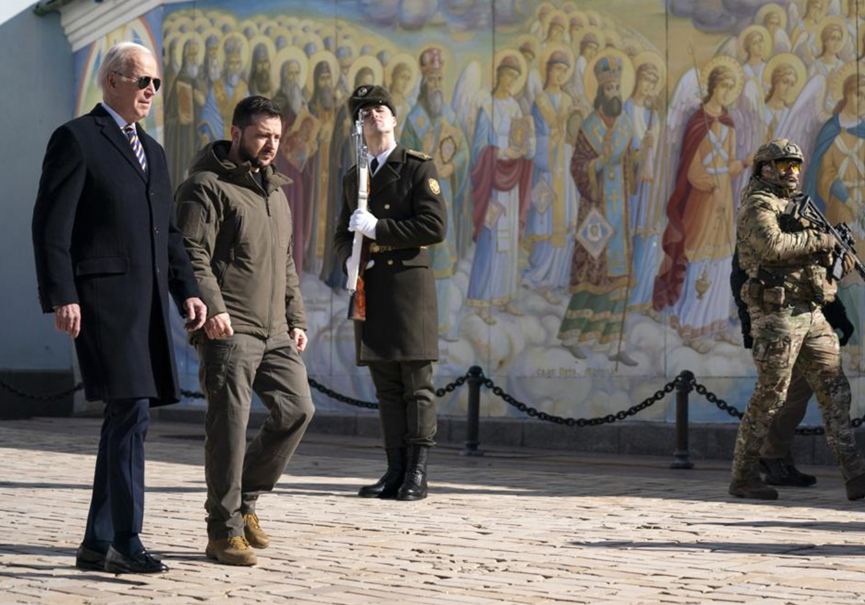
In the five hours of their stay in Kyiv, Biden also visited the landmark St. Michael's Cathedral in Kiev, together with Zelensky, and presented a wreath for Ukrainian soldiers who had died since 2014 in front of the memorial wall there. In addition, in accordance with established practice, he visited the United States Embassy and met with its staff. At 1.10 p.m., Biden boarded the same train station and returned to Poland, planning to deliver another speech on the Russia–Ukraine conflict in the capital, Warsaw, on the 21st.
“This is really a bold adventure.” A White House official said to the media. Although Russian troops withdrew from the northern part of Ukraine and the surrounding areas of Kiev in March last year, Kiev continues to face the threat of Russian military warplanes, missiles and suicide drones. According to the Associated Press, just as Biden visited the St. Michael's Cathedral in Kiev, the air strike alarm in Kiev was sounded, and Biden was “capturing a feeling of the people of Kiev for a year”. The New York Times, for its part, writes that no president has been so close to the battlefield since Abraham Lincoln rode to the front of Washington during the civil war.
In the column dedicated to the return journey, Sullivan stated to journalists that the trip was extremely risky, “including the fact that we are still at risk”, but to avoid “the miscalculation of the two nuclear-weapon States in direct conflict”, the United States informed Moscow of this information before Biden arrived in Kiev.
In order to ensure the absolute security of Biden, the White House has been struggling with confidentiality and security. The New York Times published a number of details of the journey. Long after the announcement of Biden's visit to Poland, there have been many speculations that Biden might take the opportunity to visit Ukraine, so that the White House would have to break the practice of “placing the secret journey after the public trip” and place the Biden visit to Ukraine before its visit to Poland in order to confuse the public record. Following Biden ' s entry into Ukraine, the White House also published a public itinerary that falsely stated that the President was still in Washington and would not travel to Europe until night 20th.
The traveller is much fewer than usual, except for the accompanying officer, the bodyguard, the assistant with the “nuclear suitcase”, a small medical team and the White House photographer. This time, compared to the 13 members of the press corps previously, only one Wall Street Journalist and one Associated Press journalist were authorized to accompany them, who made a confidential oath in the White House to ban the carrying of communications equipment for the entire period. A few hours before the beginning of the press conference between Biden and Zelensky, a few Ukrainian journalists were summoned to a hotel in the centre of the city, where they were told the President was about to arrive shortly before Biden appeared. Following Biden ' s entry into Ukraine, the United States Air Force took off from its fleet, including the E-3 early-warning aircraft and the RC-135W electronic reconnaissance aircraft, and arrived in Polish airspace close to Ukraine to monitor possible battlefield movements.
It's more political than real, and the war is still hard to end.
Since the outbreak of the Russia–Ukraine conflict, and particularly after the withdrawal of the Russian forces from the Kiev region, foreign dignitaries have chosen to visit Kiev as an expression of their support for Ukraine, with the current British Prime Minister, Sunak, former Prime Minister Johnson, French President Marlon, German Prime Minister Scholz, Italian Prime Minister Draghi, Romanian President Johannes, and the President of the European Commission, von der Lehn, visiting Kiev and meeting with key officials such as Zylinski. For its part, the United States military and political figures, including Secretary of State Brinken, Secretary of State Austin and Speaker of the House of Representatives Palosi, also visited Kiev in one year. Biden himself visited Kiev six times, and his last visit was during his Vice-President ' s term in 2017.
This sudden visit by Biden can be seen as a return visit to Zelenskyâs covert visit to the United States last December, but on the eve of the first anniversary of the Russia–Ukraine conflict, it is undoubtedly a more significant political gesture, both in terms of expressing to Russia the unity of the Western countries and in terms of showing to some of the still-swaying European countries Americaâs attitude on the Russia–Ukraine issue, and in terms of demonstrating to the Republican right-wing factions the strategic decision of the current administration to support the Ulu.
At a time when the fighting in eastern Ukraine is at an impasse, the visit by Biden undoubtedly injects a strong dose into Ukraine. In a joint statement, Zelensky hailed Biden ' s visit as the most important visit in the history of U.S.-American relations. For its part, the Minister for Foreign Affairs of Ukraine, Kulyba, called it “a major victory for the people of Ukraine and the President of Ukraine”. The head of the Office of the President of Ukraine, Andrei Yalmak, also praised the visit as “strategic” and historic. In its article, the Atlantic Association stated that, as Russia faced a disadvantage in the front-line fighting, Moscow placed its hopes of victory on the inside of Western countries, but in this journey Biden directly challenged Russia's “unrealistic expectations” and made a clear commitment that the United States would support Ukraine for the long term, indicating that time was not on Putin's side.
The popular reaction was equally lively, with a Kyiv citizen saying to NBC news reporters: “It is remarkable that our foreign partners have witnessed everything, despite the dangers. As a person living in Kiev who will soon be heavily shelled, I feel well today.” After the news of Biden's visit to Ukraine was made public, there was a rapid discussion of the matter in social media in the United States, and the images of Biden during the visit were disseminated on various platforms, becoming a mimic (the “block” understood on the Chinese Internet): in one picture he was eating ice cream cones with a sign of sunglasses; in the other, he was shopping in a grocery store and stated that the egg price was too high. The widespread dissemination of these stereotypes has undoubtedly helped to add value to the image of Biden as a “people-friendly” and CNN has also reported that such a journey requires energy and patience, and that it is a difficult and dangerous journey “as if it is a vehement attack on critics who question whether Biden should stand for re-election at the age of 80”.
According to NBC News, at a time when Putinâs high-profile announcement of an important State of the Union address on the first anniversary of the Russia–Ukraine conflict, Bidenâs unexpected visit was undoubtedly a âsnatch-upâ to Ukraine, and it was important to show unity and determination before Ukraineâs opponents were ready for help.
In response to Biden's trip, Taslis quoted Medvedev, Vice-President of the Russian Security Committee, as saying that he had received “security assurances” before the Biden trip, but did not indicate who had provided them. Medvedev also stated in social media that Biden had “at last gone to Kiev and promised to provide many weapons and pledge allegiance to the neo-Nazi regime until death”. In addition, CNN quoted two United States officials as saying that on the same day that Biden visited Kiev, Russia had tested an RS-28 “Salmat” intercontinental ballistic missile, but the launch appeared to have failed. “Salmat” is the new and sharp force in Russia's land-based strategic nuclear weapons arsenal, with a range of about 18,000 km and its first successful test launch in April 2022. It was reported that the Russian side had notified the United States prior to the launch of the missile, but the current source was unable to determine whether the launch had taken place during Biden ' s visit to Kyiv.
The Russian-Ukrainian conflict is no longer among the issues most attractive to the American population, despite the fact that, on this occasion, American society’s attention returned briefly to Ukraine. Accordingly, doubts have long been raised over the Biden Government ' s aid scheme in the field. A poll conducted last week by the Associated Press-NORC Research Centre for Public Affairs found that American support for Ukraine’s assistance has diminished, with only 48 per cent of Americans supporting the supply of weapons to Ukraine, well below 60 per cent last May. A survey by the Pew Research Centre, following Biden’s announcement at the end of January that it had supplied Ukraine with the main battle tank “Abrams”, also showed that about a quarter of Americans indicated that the United States had provided too much support to Ukraine, an increase of 6 percentage points from last September and 19 percentage points from last March.
For her part, Congressman Marjorie Taylor Greene of Georgia quickly criticized Biden's visit to Kiev, saying, “This is an incredible insult. Today is our presidential day, when United States President Joe Biden chose Ukraine over the United States, forcing its people to pay for the Ukrainian Government and war. I cannot say how much the Americans hate Joe Biden, and “other Republicans have accused him of “giving more to the borders of Kiev than to the borders of the United States”. CNN analysed that many right-wing voters felt that Biden was not doing enough to secure the southern border of the United States and that the issue would be at the heart of the 2024 elections.
At the same time, for Ukraine, the prospects for war are not as optimistic as they seem. According to a report by Bloomberg, although countries had previously committed to sending advanced main battle tanks, the weapons were at least a few months away and some countries were delaying the schedule. For their part, the United States Republicans have been raising their voices to question financial support on such a scale. More crucial, given that the Russian and Ukrainian sides have been waging large-scale combat operations over the past few months, there is widespread speculation that this augurs well for the build-up of both sides in subsequent operations, with yet another large-scale conflict coming in the spring. Therefore, Ukraine, which vows to launch an attack, has an extremely urgent need for all types of weapons and ammunition, in particular tanks, self-propelled artillery, long-range weapons and military aircraft of all types. Although Biden announced a new military assistance plan during this trip, it does not include the ultra-moderate weapons and fighter planes that Zelensky has been demanding. In addition, the columnist for the Financial Times, Gideon Rahman, states: “The Ukrainian economy is in deep trouble and depends on Western aid. Therefore, influential Western analysts believe that time is not on Ukraine's side — if Kiev is to win, it must be won as soon as possible.”
Read the complete article in its original context.
Fudan Center for China–U.S. Cooperation · February 23, 2023 · Chinese
Open the original Chinese article