

Editor’s note This is a complete English translation of the published Chinese article, with publication chrome, image captions and account notices omitted. Facts, estimates and framing reflect the original publication date. The Chinese original remains available through the source link below.
What are the exam-takers really trying to solve?
This piece grew out of everyday conversations with GPT about books I had not yet found time to read, courses I still remembered and reflections from a year of work. The passages below were excerpted from GPT’s responses without alteration. I assembled them as a record of a conversation; their inclusion does not imply my endorsement and they are offered only for reference.
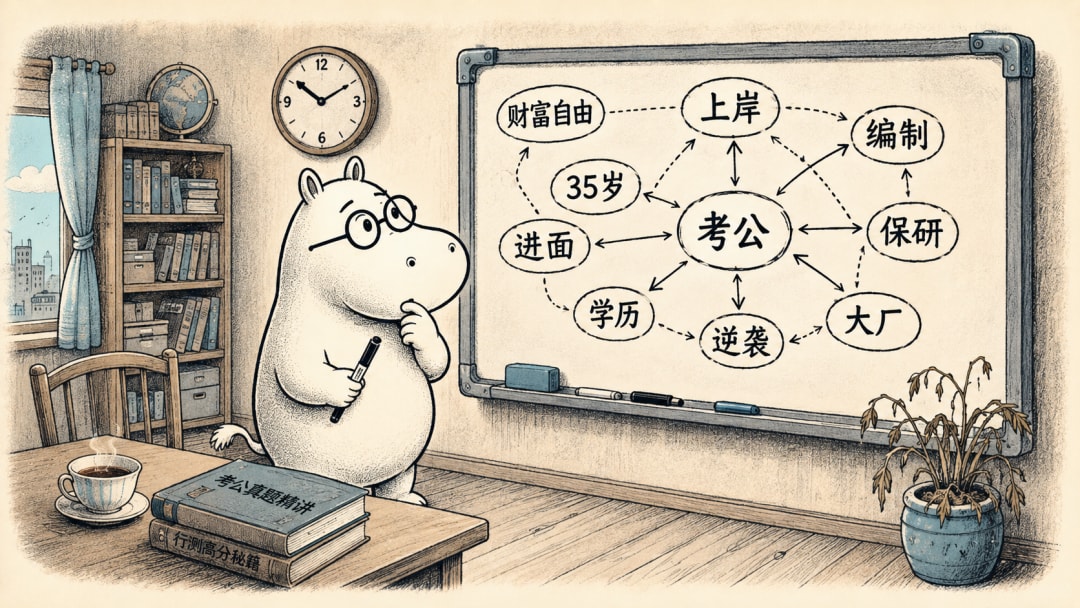
Many of the most popular expressions on the Chinese internet carry the atmosphere of an examination hall. At each stage of life, people hope to ‘reach shore’, as if everything before that moment were spent drowning. They rank cities, universities, careers and lifestyles from ‘top-tier’ to ‘trash’, as though the world were a report card waiting to be posted. Whether the subject is the small-town exam-taker, the declining value of degrees, the civil-service craze, emigration studies or class mobility, the underlying anxiety is the same: where do I rank, have I passed, and what must I complete before my life can no longer be questioned?
The exam-taker’s life is not understood as a process that unfolds and can be revised. It is organised as a long ordeal, followed by a moment of judgement that decides everything, followed in turn by a new world in which fate has been rewritten. The gaokao is the purest model. Twelve years become preparation and ascetic practice; the examination room becomes a last judgement; the score delivers a final verdict on every effort; university is imagined as the other shore of salvation. A complex, gradual and contingent process of social mobility is compressed into a single moment of ultimate meaning.
This narrative also contains a moral economy of suffering. Hardship is not only a means to an end but a currency supposedly exchangeable for results. Rising early, staying up late, giving up leisure and enduring humiliation all prove that one deserves success. If success does not arrive, society first asks whether the individual worked or suffered enough, rather than examining competition, educational quality or personal circumstances. Grades become a divine judgement on devotion. The deepest problem with an extreme examination regime is not only its schedule, but the way bodily pain is publicly displayed as loyalty and self-suppression becomes evidence of worthiness. Effort can raise the probability of success, but pain does not itself create value; discipline may work, but suffering is not inherently deserving of reward.
This is a secularised messianic conception of time: not a strict restatement of any theologian, but a basic structure in which the present is suffering, the future holds a moment of judgement, and beyond that judgement lies a wholly different world. It refuses to see life as continuous, ambiguous and revisable, concentrating hope instead in a single turning point. Pain acquires moral value: the more I have suffered, the more the future owes me; if compensation does not arrive, either I have not worked hard enough or the world is in my debt.
The structure then migrates almost unchanged into adult life. A good university fails to deliver the promised shore, so the messianic moment is postponed: after postgraduate admission, a civil-service post, a major technology company, a promotion, a household registration, a home, marriage, migration or financial freedom, life will finally begin. Every stage demands that life be temporarily sacrificed in return for compensation at the next, only for the next stage to become another ascetic beginning. This is not healthy delayed gratification, which knows that future rewards are limited and the process itself belongs to life. Messianic delay denies the present any independent value.
Looking back, the exam-taker may feel a peculiar emptiness: every test was won and every milestone completed, yet the promised life never arrived. The attraction of ‘reaching shore’ is not merely income or stability; it is the fantasy of never again having to answer whether one is good enough. Universities, jobs, cities, partners and even hobbies are drawn into the same ranking system. A hierarchy from top-tier to trash is seductive because it briefly makes the world legible: identify the top, stand on its side, and life appears to have a correct answer.
Where else is the exam being taken?
Move to another corner of the internet and a different vocabulary appears: the ‘top three permanent members’, ‘G2’, ‘we have already won’, ‘something big is coming’. At the collective level, the exam-taker mentality becomes a wait for a decisive historical contest. National rejuvenation, technological breakthroughs, defeating the other side—and in some populist imaginations, war and epochal upheaval—promise that past humiliation will be settled, every sacrifice explained and a strong, complete world beyond bullying finally delivered.
When ordinary upward mobility becomes difficult, this expectation intensifies. Those unable to change their place in normal time begin to hope that exceptional time will reshuffle the rankings. If the individual cannot reach shore, perhaps the whole community can reach shore together through a grand victory. The logic often runs as follows: international society recognises only power, not morality; international law is merely a tool by which the strong restrain the weak; if Western countries break rules, we need not obey them; and once the state is powerful enough, neighbouring societies will accept reality.
That is more than realism. Realism recognises friction, miscalculation and uncontrolled escalation, and knows that nationalism in smaller states does not disappear because a great power announces the direction of history. What emerges instead is a vulgar social Darwinism, sometimes assembled from decontextualised popular fiction such as The Three-Body Problem. International politics becomes a jungle, restraint becomes weakness, empathy becomes naivety and power itself becomes the sole source of legitimacy.
Although intensely anti-colonial in name, this outlook repeatedly reproduces a colonial gaze. Smaller neighbouring countries are treated as pieces without full agency: closeness to us follows history, while distance must be foreign manipulation. Development becomes a civilisational hierarchy. Great powers are assumed to possess natural spheres of influence, while a small state seeking security is cast as the provocateur. Direct occupation is unnecessary; the assumption is simply that strong countries have greater rights to interpret history, draw security boundaries and decide a region’s future. The irony is that people can hate the power politics once imposed upon us while imagining the ability to dominate others as history’s final justice. Empire is not rejected; its position is desired.
Several historical moods are compressed together: the status anxiety of a rising Wilhelmine Germany, interwar memories of humiliation and the urge for revival, a Cold War security state’s sense of encirclement, and the low-cost populist chauvinism of social media. The danger begins when coercion is granted moral immunity because ‘we were once victims’. What appears to worship hard realism is actually a romantic, anti-modern impulse tired of compromise, legal procedure, interdependence and prolonged negotiation. It wants one magnificent struggle to restore community, heroism and historical meaning.
People say they respect strength, but often they long to be carried out of ordinary life by a force larger than themselves and to prove who ‘we’ are through a grand event. Individual and collective exam-takers alike treat the long, complicated work of coordination as an impure intermediate state, placing real meaning in one final match and believing that greater sacrifice makes victory more sacred.
Messianic imagination itself is not the danger; every society needs some promise of a future. The danger is the growing resonance among personal salvation, collective rejuvenation and the state of exception. The individual believes life begins only after winning a position; the grand narrative believes rejuvenation arrives only after a historical mission; the disappointed believe only an upheaval can cancel the old ranking. All three reduce ordinary life to a prologue. During rapid growth, this structure can produce discipline, saving and striving. As growth slows, it can become resentment, fantasies of resetting everything and romanticism about war. People did not suddenly become more aggressive. The promise of salvation once partially redeemed by growth stopped working, and accumulated sacrifice began to search for a new explanation.
When did the exam-taker begin taking exams?
The individual fixation on credentials, careers and reaching shore and the collective pursuit of historical position appear to operate at different scales, yet both share a basic temporal structure of modern China. To understand when the exam-taker began, we must go beyond the gaokao and contemporary involution to a deeper shift since the late Qing: history changed from a cycle into an arrow, and the future gained greater authority than the past.
The modern world system brought not only military defeat but the collapse of an existing civilisational coordinate system. China moved from the centre of an all-under-heaven order to the position of a latecomer required to prove itself through industry, technology, organisation and state capacity. A durable modern sensibility followed: backwardness meant danger as well as poverty; change was needed not only to live better but to qualify for continued existence in history.
Individual liberation was therefore entangled with collective destiny from the beginning. The May Fourth generation asked young people to leave family hierarchy and ritual behind, but the individual who left did not enter a quiet private world. He or she was immediately charged with transforming society, creating a new culture and carrying the age. After Nora left the family, she often walked into nation, revolution and history. Over the next century, China produced successive ideal persons: the new citizen, the new youth, the revolutionary, the worker, the professional, the entrepreneur, the urban middle class and the striver. Their values differed, but all assumed that the existing self was insufficient and had to be remade through education, discipline and labour before entering the promised future.
The revolutionary era concentrated this structure. Personal value came from joining an emancipatory cause larger than oneself, and poverty, restraint and sacrifice became costs of historical transformation. Reform and opening changed the mechanism of progress without erasing its future-oriented time. The revolutionary gradually became the striver; class liberation became class mobility; the ideal society was translated into moderate prosperity, housing, degrees, careers and a place in the city. Life once postponed for a new world was now postponed for family improvement and the next generation.
For a time, the state becoming strong through development, the family changing its fate through education and the individual rising through examinations looked like different levels of the same problem. Under continued growth, national construction, family improvement and personal success confirmed one another. Effort no longer needed to be justified as changing the world; people could say openly that they wanted a better life for their families, a larger city, a wider world and a decent, stable existence.
Yet the revolutionary horizon did not disappear. It was domesticated, secularised and measured by performance. ‘Bitterness first, sweetness later’ moved from political sacrifice into developmental asceticism: study first, then work; work overtime first, then buy a home; establish yourself first, then begin living. The gaokao became more than selection. Schools told individuals that years of endurance and one examination would change their fate; modern history told the community that long accumulation and one decisive competition would secure a new position. Individuals waited for admission letters while the community waited for history’s recognition; individuals feared falling behind while the collective feared backwardness; grades proved personal worth while development proved the national path.
The exam-taker mentality can therefore be seen as survival modernity condensed into everyday life, while grand historical narrative projects examination society onto the collective scale. The structure released real power: it expanded education, built industry and enabled mobility. It was not merely an illusion but a social contract that was partly honoured—today’s endurance could purchase tomorrow’s life.
The decisive change came when that contract grew unstable. When growth, employment, housing, educational returns and global mobility all became uncertain, people lost more than an opportunity; they lost faith in messianic time. They could no longer be certain that answering one more question today would move them closer to tomorrow’s answer. Some intensified their pursuit of certificates, civil-service examinations and protected positions. Some chose lying flat, low desire or departure. Others turned to nostalgia, mysticism and fantasies of vast upheaval.
These reactions appear opposite but all search for a temporality to replace developmentalism. The mood of ‘we might as well begin again’ looks destructive, yet beneath it remains a desire for salvation—not for suffering itself, but for a judgement that cancels old scores and redistributes chances. Meanwhile, collective, family and individual time no longer align automatically. Public narratives emphasise long-term development, autonomous capacity and external competition; middle-class families focus on assets, education and security; young people focus on self-preservation, mental health and avoiding exhaustion. They need not be enemies, but they no longer lead naturally to the same future. Macro-history retains direction while micro-lives feel increasingly adrift.
The exam-taker, then, was not born upon entering an examination room. He was born when modern China understood survival as catching up, personal growth as self-remaking and today as preparation for tomorrow. The question is not whether effort matters. It is whether, when the promised future fails to arrive, we can still trust ordinary life, gradual change and an existence that requires no final judgement. Security comes not only from winning competitions, but from believing that tomorrow can still be reached from today, step by step, even without one examination that decides everything.
How might we stop taking the exam?
For more than a century, Chinese social thought has repeatedly answered three questions. How could China avoid disappearance? The answers were the nation-state, national salvation and revolution. How could China escape poverty? The answers were developmentalism, markets and a performance society. A third question is now emerging: after becoming a powerful modern state, what should people live for, and what makes a society worth living in?
Power, growth and organisational capacity provided relatively clear answers to the first two questions. The third involves dignity, freedom, equality, care, public life, the human relationship with nature and the meaning of a finite life. Greater national strength cannot resolve it automatically. Modern thought has long placed human happiness after the completion of a historical task: save the nation, then build it; industrialise, then improve life; become rich, then address fairness; complete rejuvenation, then discuss how individuals should live.
Each postponement had practical reasons and produced extraordinary achievements. Repetition, however, creates a structural habit in which the present is always an instrument and concrete lives can always yield to a larger future. A new meta-narrative cannot merely supply a more distant and magnificent destination. It must explain how people can live today—with dignity, relationships and public agency—without waiting for history to declare victory.
Such a narrative would acknowledge the need for state capacity and community while limiting the unlimited requisition of particular lives by distant goals. It would preserve markets and personal choice while rebuilding public provision, solidarity and ordinary people’s bargaining power. It would value civilisational continuity while allowing individuals freely to inherit, interpret or refuse tradition. It would recognise global competition without turning permanent emergency into life’s total meaning. Its centre would not be the production of an all-capable new person, but a society that permits ordinary people to fail, change direction, rest, love and begin again.
Perhaps the deepest continuity in Chinese intellectual history is the demand that people remake themselves for a world not yet arrived. The threshold before us is whether a nation can retain historical direction while finally recognising present life as an end in itself. For the individual, overcoming messianic time does not mean abandoning ideals, effort or criticism of reality. It means abandoning the fantasy that one moment can solve life and history once and for all, and therefore ceasing to search for an identity that will permanently prove one’s worth.
Degrees, official positions, companies, cities and overseas identities may all improve life, but none can end vulnerability and uncertainty. A reliable life is not one that has finally reached shore; it is one that has learned how to move in the water—to fail, change routes, learn again and continue without a standard answer. What a person needs is not one ultimate admission but many small passages that are low-risk, repeatable and open to correction.
Maturity for a community likewise does not mean losing historical direction. National destiny, civilisational continuity and social progress still matter, but collective meaning cannot forever rest on waiting for final victory. A liveable society cannot promise happiness only after victory. Before history is complete, it must already provide dignity, relationships, security and public agency. A strong community should not endlessly demand proof of loyalty to the future; it should be able to contain ordinary hesitation, rest, failure and renewed beginnings.
Mature historical consciousness may begin by accepting that the Messiah will not come. No examination can complete life, no victory can permanently end vulnerability, and no grand future deserves to turn the present of generation after generation into a prologue. We can still build the future seriously, but we cannot wait for the future to authorise us to begin living.
If there is a messianic moment available to us, it may not be history opening the gates of heaven. It may be the moment we stop waiting. A future worth reaching should not require life to remain permanently on hold. It must begin today: in every relationship not sacrificed, in every institution that allows ordinary people to fail and rest, and in the moment we recognise that present life is itself an end.
Read the complete article in its original context.
O Captain · August 10, 2026 · Chinese
Open the original Chinese article