

Editor’s note This English edition consolidates four published records. Their substantive article text has been translated and arranged chronologically; platform prompts, image captions, account notices and recommended-reading modules have been removed. Passages that refer directly to Han Hao are highlighted in the two wider event reports.
From the Blue Courtyard to the East River — March 2024
Han Hao was a master’s student in International Journalism and Communication at Fudan University. From July to December 2023, he interned with UNICEF’s public-partnerships function in New York. As an Advocacy intern, he supported engagement with donors, managed social-media channels, drafted guidance materials, and produced data analysis and visual content.
I arrived in New York shortly after the summer solstice, when the sunsets were long and brilliant. From Roosevelt Island, where I lived, I could see the United Nations Headquarters across the East River. After work, I would take the tram home and sit on the lawn as the building’s glass façade reflected rose-coloured clouds. Unlike the blue courtyard in Beijing, UNICEF Headquarters occupied a light-grey building across the street from the UN. Scaffolding happened to cover its sky-blue sign when I arrived, allowing the understated building to disappear easily into Manhattan’s sea of offices.
Two applications, and a return to UNICEF
It took a year and a half to travel from the blue courtyard to the bank of the East River. In March 2022, just after completing my internship with UNICEF China, I saw an opening for an internship in UNICEF Headquarters’ public-partnerships team through FDG²IO. Because I had valued both the work and the atmosphere of UNICEF, I applied and reached the interview stage. David Evans, a senior adviser in the division, led the conversation. His connection with China and evident affection for Chinese culture made the interview feel more like an open exchange than an examination. I was not selected that time, but I held on to the possibility of returning.
Six months later, when the previous intern’s term ended, the role was advertised again. Encouraged by my teachers, I applied for a second time, passed the written test and met David again. To my surprise, he remembered me and was pleased that I had returned. After another fortnight of waiting, I received the offer and renewed my connection with UNICEF.
Work at Headquarters
July is the height of the summer-holiday season in the United States, and much of the office was away. My supervisor, Emil, nevertheless introduced the division with remarkable efficiency and showed me around. Because I had only just landed in New York and was still adjusting to the time difference, he told me to prioritise rest rather than force myself into an early-morning routine. The human care and friendliness I had known in UNICEF China were immediately recognisable.
Interns were assigned according to their expertise and the division’s needs. With a master’s specialisation in international communication, I joined the Advocacy team within Public Partnerships. The team maintained relationships with UNICEF’s public-sector donors—including governments, public foundations and public institutions—and reported on how contributions were used and how partners were recognised. It also maintained a group of accounts on X, Facebook and Instagram. The role matched my background in political science and journalism and communication.
My first stream of work was to support UNICEF Public Partnerships’ social-media matrix. Although English was not my first language, I created content for global communications: editing video messages sent by national delegations in Adobe Premiere Pro and producing diagrams of donation and mobilisation mechanisms in PowerPoint and Adobe Illustrator. Distributed through UNICEF’s channels, this material supported the organisation’s global advocacy and visibility.
My second major assignment was the 2023 Public Partner Visibility and Recognition Handbook. Updated annually for UNICEF staff worldwide, the handbook distilled the division’s experience into practical guidance for recognising public partners and sustaining cooperation. Under Emil’s supervision, I handled the drafting and revision. Across four months and ten versions, the handbook was completed ahead of schedule and launched at an all-hands meeting. More than 80 per cent of the previous edition was revised and over 20 per cent new text and graphics were added. Seeing a concrete product of my own work published and recognised by colleagues was an especially strong source of accomplishment.
The third stream involved targeted data analysis and visualisation. To understand the audience of one UNICEF account and improve its operation, I built a dataset, labelled and classified several thousand user records, and used Stata to conduct correlation analysis and forecasting. The result was a detailed audience profile and five operational recommendations, presented in a slide deck to the head of the division. Drawing on an earlier consulting internship, I also supported several other internal analyses and presentations.
In New York, where world politics was taking place
Beyond the formal duties of the role, the internship placed me close to major moments in global governance. During the UN high-level week in September, meetings including the General Debate and the Sustainable Development Goals Summit filled Midtown East. Streets were closed for delegations from around the world. For a student who had studied political science, it was the first time that the world’s most important multilateral setting became tangible: senior delegations moved past one another, familiar figures from the news appeared at close range, and greetings and urgent consultations revealed the pulse of politics. I came away believing more strongly that frank communication, mutual respect and good faith can make the world better. In the entrance lane used by interns and media, I also happened to pass Kazakhstan’s President Kassym-Jomart Tokayev. I could not approach him because of protocol, but the moment stayed with me: the world was moving in front of us.
Alongside other interns, I listened to national statements in the General Debate and was struck by the variety of ways countries understood the age in which we live. It was a rare opportunity to hear many nations articulate their ideas of the world and development in succession. We also attended Security Council discussions on regional crises, from the continuing war in Ukraine to the renewed Israel–Palestine conflict. After one such session, a large pro-Israel demonstration filled 47th Street outside Headquarters; the next day, pro-Palestinian demonstrators gathered in the same place. Police helicopters thundered overhead while chants overwhelmed every other sound. Global governance and world politics were not abstractions floating above ordinary life. They were vivid events unfolding every day.
Crossing one mountain, then another
Compared with my UNICEF China internship two years earlier, New York gave me a deeper sense of global governance as a dynamic, physical and fluid process. The world’s prevailing impulse, I felt, was still a desire for peace and exchange, and a belief that human intelligence could combine to move civilisation forward. At the centre of multilateral governance, I also felt the respect colleagues accorded China. Chinese staff and interns were increasingly visible across the UN system, while colleagues from other countries wanted to understand China’s position and recognised its growing role. Chinese professionals with long experience in the system took seriously the development of a new generation, encouraging interns and younger colleagues to speak with confidence and continue further along this path.
I also met generous friends whose lessons in professional ability and career development rivalled anything I had learned in a classroom. Their work in partnerships, cross-cultural exchange, Asia-Pacific affairs and public health showed me different ways in which international cooperation reaches those who need it. Their company gave my months in New York a warm cast and left me with a simple conviction: when people like this are doing the work, the world cannot become entirely worse.
By coincidence, the final day of my internship was also my birthday. Friends and I crossed First Avenue to take farewell photographs in the UN garden, and my supervisor organised a generous send-off. We sat around the table that had hosted so many meetings and meals, talking about careers and about New York’s absurdity and beauty. At Grand Central, I said goodbye beneath a night sky whose clouds looked like the mountain ranges of home.
The first text I studied in secondary school was the poem Beyond the Mountain. It captured the story of our generation: our parents moved from mountains into towns during reform and opening, while the country stepped gradually onto the world stage. Those of us who grew up with China’s WTO accession, the Beijing Olympics and the Shanghai Expo inherited part of that progressive narrative. Through education, we cross mountain after mountain, travel beyond seas that once felt impossibly distant, enter new lives and seek to realise our value as the world moves forward. Our generation and our world keep crossing mountains. I like that feeling.
The Blue Courtyard in My Heart — May 2022
Han Hao, then an undergraduate in Fudan University’s School of International Relations and Public Affairs, was recommended by the university for an internship with UNICEF China. As a Translation and Research intern, he supported routine coordination between UNICEF and the China International Development Cooperation Agency’s South-South Cooperation Assistance Fund, translated Chinese and English materials for maternal-and-child-health and pandemic-response projects in African countries, and assisted research on China’s foreign-aid policy.
Turning from the Agricultural Exhibition Center into Dongzhimen Outer Street and passing beneath a long canopy of trees, one reaches Sanlitun Road among rows of national flags. Summer in the embassy district recalls Jiang Wen’s film In the Heat of the Sun: cicadas sound without becoming tiresome, and white morning light slowly turns orange through broad plane-tree leaves. Between the towers of Sanlitun SOHO and older brown apartment blocks, UNICEF’s blue courtyard rests quietly amid the traffic beneath a blue summer sky.
Between the front and rear buildings lay a lawn. The Public Partnerships Sector looked onto it through full-height windows, combining stillness with the centre of the city. The office was full of laughter and easy greetings. My favourite place, however, was an unassuming meeting room with a corrugated roof, folding chairs and a portable screen. It could become a flea market, an all-staff meeting room or an informal gathering space. Its simple, adaptable design created an unusual sense of warmth and solidarity.
Friendship in the courtyard
Soon after I joined, a lively and approachable woman walked into our office, greeted colleagues and formally welcomed the new staff. Only later did I notice her portrait in the corridor and realise that she was Cynthia McCaffrey, UNICEF Representative to China. The lack of hierarchy and the friendliness of the workplace were immediately apparent.
That care continued throughout the six months. Colleagues arranged my onboarding, answered even my most basic questions and included me in office life. When I first received an invitation to a ‘cake cutting’, I mistakenly arrived with my laptop and a folding stool, thinking it might be a new term for assigning work. Instead, colleagues brought out a cake for a birthday. Months later, while working remotely in Shanghai on my own birthday, a colleague arranged a bear-shaped cake on behalf of the whole team. At the end of the placement, every member of the sector wrote in a long card and placed it in a UNICEF gift box with a photograph into which they had carefully added me. In Shanghai’s grey winter, I received a box of blue summer.
Translation, research and the machinery of assistance
My work had two main parts. First, I translated and edited Chinese- and English-language materials for UNICEF’s coordination with the South-South Cooperation Assistance Fund. These included interim and final reports, supply tables and correspondence for maternal-and-child-health and pandemic-response programmes across Africa.
The programme I encountered most often supported maternal and child health in eight African countries. Beyond medicines and large pieces of medical equipment, it invested in the capacity of frontline health workers so that improvements could endure. For the first time, I saw closely how an international assistance programme is documented and executed: reports could specify the cost of each packet of therapeutic food, its date of arrival and the number of people reached. Behind standardised figures were the efforts of people working under difficult and sometimes dangerous conditions.
The pandemic increased both the pressure and the volume of work. Rather than pause existing programmes, the parties tried to complete their original commitments and expand coverage. I translated official correspondence among UNICEF country offices, local governments and the Chinese government. The detail of the work made both the difficulty of frontline assistance and the scale of China’s contribution tangible.
The second part of the role was research on Chinese foreign-assistance policy and comparisons of pandemic and vaccine-aid mechanisms. My political-science training proved valuable when analysing the behaviour of China and the United States across bilateral and multilateral arrangements. For an English-language report on the distinctive approaches of Chinese foreign assistance, I reviewed policy statements and information from central departments and translated political knowledge into a form colleagues could use. Across the internship, I translated more than one hundred reports and tables, as well as dozens of letters and communications materials. In the busiest periods, the work continued late into the night so that documents could reach the relevant government departments on schedule. My contribution was to be a dependable part of the mechanism that kept it moving.
What the blue courtyard left behind
The internship gave me a broad understanding of UNICEF’s work, its relationship with Chinese government institutions and the role international organisations play in development cooperation. Among major donor countries, an international organisation can serve as a platform that translates resources and political willingness into programmes; in developing settings, it may also supplement local state capacity and respond directly to need.
The experience also made China’s role in international assistance concrete to me. As the pandemic intensified anti-globalisation and war again harmed women and children, UNICEF—created from the ruins of the Second World War—continued to work on the front line of crises. I was proud to have served, at twenty-one, as one small component of that effort. Wherever I go, the blue courtyard of that summer will remain with me as evidence of the world’s capacity for warmth and solidarity.
UNICEF China Delegation Visits Fudan University — May 2023
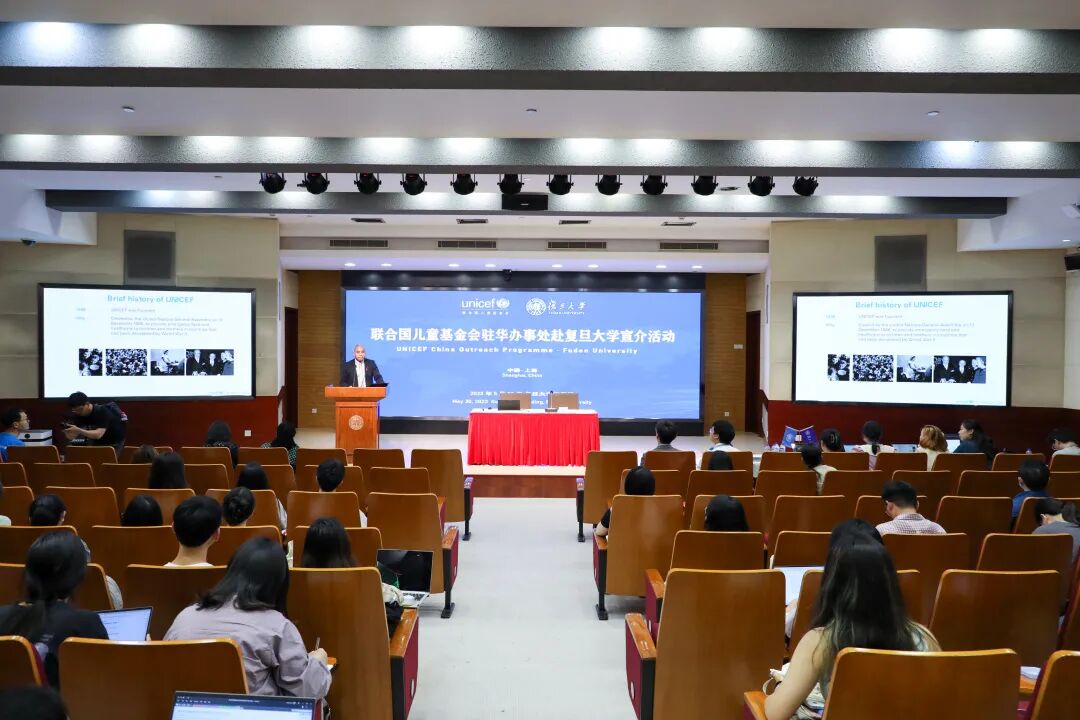
On the afternoon of 30 May 2023, a UNICEF China delegation led by Acting Deputy Representative Patrick Shing visited Fudan University for a roundtable and an FDG²IO Lecture. University administrators, career-service staff and former interns joined the discussion. The public lecture drew 170 students from 26 universities in Shanghai, together with 94 graduates of the fourth ‘Empowering Young Talent’ international-competence programme.
At the roundtable, Chen Jie, Director of Fudan’s postgraduate affairs department, reviewed the university’s cooperation with UNICEF and its work with international organisations on talent development. She described such cooperation as an ongoing priority and expressed the hope that internships could support deeper academic exchange, staff interaction and new forms of partnership.
Patrick Shing outlined UNICEF China’s work in child protection and development, health, poverty reduction and policy advocacy. Reviewing earlier cooperation in academic practice, events and internships, he said that UNICEF attached great importance to ties with higher-education institutions. Fudan was one of UNICEF China’s most important university partners, and both its experts and the interns it recommended had earned strong recognition.
The intern representatives were Han Hao, a 2022 master’s student at Fudan’s School of Journalism, and Tao Sining, a 2019 undergraduate at the College of Foreign Languages and Literatures. Han reviewed his main responsibilities and what he had learned at UNICEF China. Inspired by that experience, he had successfully applied for another internship at UNICEF Headquarters and would soon travel to New York to renew the connection. Tao spoke about UNICEF China’s warm working environment and said the experience had led her to continue in education and social development through graduate study at Harvard. UNICEF China’s human-resources manager also commended the internship partnership and the performance of earlier interns.
After the roundtable, Han Hao moderated the FDG²IO Lecture. Patrick Shing delivered a keynote on UNICEF humanitarian action, tracing the organisation’s development since 1946 and explaining how rising humanitarian crises had shaped minimum standards and the cluster approach to coordinating partners. UNICEF colleagues then introduced the organisation’s values and competency framework, discussed country-sensitive practice, and explained work across child protection, survival, education, emergency response, social policy, gender, innovation, supply, research and analysis.
During the question-and-answer session, students discussed coordination between UNICEF and UNESCO, relationships among headquarters and regional offices, and ways to reach and empower children directly affected by policy. The report noted that Fudan and UNICEF had maintained cooperation since 2018 across internships, visits and academic practice. That morning, the delegation had also opened a youth photography exhibition on disability inclusion at Fudan’s Handan campus.
SIRPA Welcome Ceremony — September 2019
On 17 September 2019, Fudan University’s School of International Relations and Public Affairs held its welcome ceremony in the Xie Xide Auditorium. Members of the 2018 undergraduate cohort, incoming master’s and doctoral students, school leaders and faculty attended.
Professor Zang Zhijun spoke on behalf of the faculty. He encouraged students to develop complex and multidimensional thinking, broaden and deepen their analysis, establish convictions and preserve intellectual passion. As members of the twenty-first century’s emerging backbone, he said, their study and work were inseparable from the future of the country and the nation.
Undergraduate representative Han Hao, doctoral representative Yao Le and international-student representative Severin Borenstein then addressed the audience.
Han Hao, an undergraduate in the 2018 Political Science cohort, began with his own story about the national anthem and reflected on how the state becomes connected with the individual. He described how the school’s commitment to rigorous inquiry and practical service had taken root in his studies. He hoped his generation would carry forward the spirit of ‘Excellence for Public Service’ and grow together with the country on the broad stage of their time.
Yao Le spoke about returning to doctoral study after two years of work, while the international-student representative described his anticipation of studying Chinese language and culture. Dean Su Changhe closed the ceremony by recalling the school’s tradition of serving national and global governance and encouraging students to act with responsibility. The ceremony ended with the university anthem, marking the beginning of a new stage for the incoming students.