

Editor’s note This is a complete English translation of the published Chinese article, with publication chrome, image captions and account notices omitted. Facts, estimates and framing reflect the original publication date. The original Chinese article was published under Han Hao’s pen name, Chen Changdao. The Chinese original remains available through the source link below.
One of the first years of the Russia–Ukraine conflict: heavy losses and unexpected battles.
A full year has passed since the full outbreak of the Russia–Ukraine conflict. On 21 February 2022, Russian President Putin made a televised statement announcing the immediate recognition of the âDonetsk People's Republicâ and the âLugansk People's Republicâ. Two days later, Russian forces crossed the border and launched âspecial military operationsâ against Ukraine aimed at âdemilitarizing and de-Naziizingâ. So far, this protracted armed conflict has profoundly changed the global geopolitical structure and has exposed the global economic and social development of the post-neo-epidemic era to an additional layer of uncertainty. How has the conflict cost both sides in the past year? What role has the United States and its Western allies played in the conflict? Will the dawn of peace pierce the darkness of war in the new year? We have written three retrospects in this regard, and today we present the first one, on both sides of the war, as well as a summary of the war, for the reader.
A war of great loss.
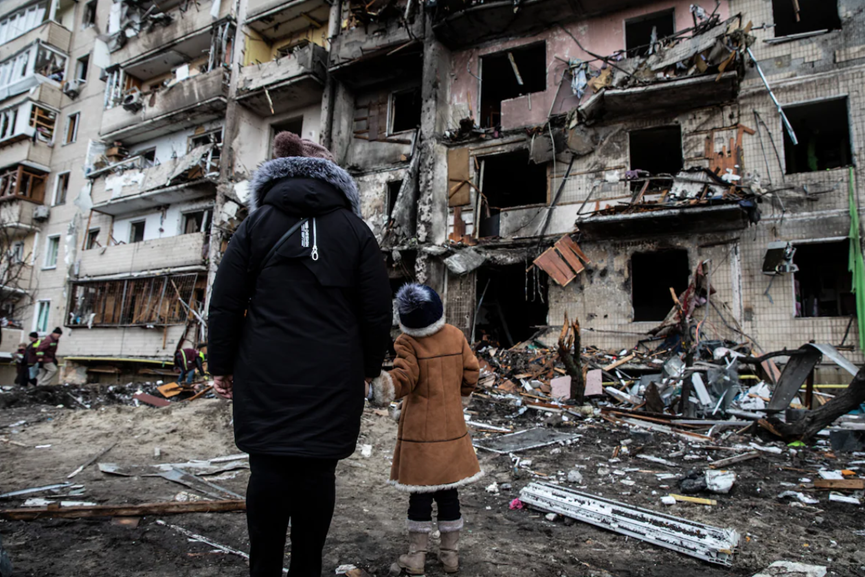
The war has brought, first and foremost, bloodshed and casualties. On 13 February, the United Nations Human Rights Office indicated that the war had resulted in the death of 7199 civilians and the injury of 1,756 civilians over the past year, while Reuters reported that the actual number of casualties would only be exaggerated. In its article, the Association for Foreign Relations estimates that the Ukrainian army and the population have paid at least 130,000 casualties, which are roughly twice the figure. In addition, some 8 million refugees had fled Ukraine and more than 5 million were internally displaced.
The United Nations Development Programme (UNDP) had warned last year that the war might lead to the collapse of Ukraine ' s economic gains over the past 20 years, and that some 90 per cent of the population was at risk of falling into the poverty line. One year has passed, and that warning has become true in part. The economic database Statista shows that the war has now caused more than $21 billion in direct economic losses, including infrastructure, environment and resources, and enterprise assets. In January of this year, the Times reported a 30 per cent decline in Ukraine ' s gross national product in 2022, an increase in inflation of 28 per cent and an unemployment rate of over 30 per cent, compared to a 3.4 per cent increase in Ukraine ' s gross national product in 2021.
The World Bank, the European Commission and the Government of Ukraine conducted a joint assessment last September on the economic costs of reconstruction and rehabilitation in Ukraine. The results showed that the total cost of completing reconstruction was approximately $34.9 billion, almost nine times the fiscal revenues of Ukraine in 2021. In addition, according to UNESCO, more than 240 cultural heritages, including monuments, museums, sculptures and religious sites, have been destroyed during the fighting.
According to Oryx, an Internet open source intelligence organization in the Netherlands, as at 24 February the Russian army had lost over 9,000 pieces of military equipment, including over 2,000 armoured vehicles, over 1,000 artillery systems and over 5,000 main battle tanks. Reuters analyses believe that the Russian army has lost more than half of its total tank. The same is true of the heavy losses on the part of the army, which has lost at least 3,000 items of registered equipment, a figure that can only be overstated in view of the large number of weapons that will soon have to be registered. The loss of these weapons equipment will not only place a heavy burden on the finances of the two countries, but may also pose a deadly threat to civilians, as large quantities of munitions that could be detonated at any time, buried mines and potentially hazardous chemical substances will continue to threaten the lives and health of generations after the war.
Behind such a heavy toll of casualties and astronomical economic losses are the continuing confrontation between the parties to the conflict on the front line and significant changes on the overall front. The real development of the front is surprising to most countries around the world, compared to the prejudicedness of the parties at the beginning of the war. On the one hand, the Russian army’s offensive has not been as aggressive as expected, while, at the same time, Ukraine’s resistance will and capacity are far greater than the outside world expected. According to The New York Times, nearly a year after the outbreak of the conflict, Ukraine has recovered 54 per cent of the territory lost since its inception, while the Russian forces still control 18 per cent of the entire territory (including Crimea).
Complex and volatile front-line situations.
Following the outbreak of the conflict on 24 February 2022, Russian soldiers attacked Ukraine in three directions and launched air strikes throughout the territory of Ukraine. The Russian forces of the North route moved from the direction of Belarus to the capital, Kiev, in the direction of Chernigov, and, as a result, the elite airborne troops set off a landing at the airport on the south-west outskirts of Kiev. From the north-east border of Ou, Russian forces from the south-east launched attacks on major cities such as Kharkov, and from Crimea, Russian forces from the south moved in the direction of Hersson, Odessa and Mariopol on the east line along the coastline.
In the spring, the front-line situation has been the most critical turning point to date. The Russian forces on the south road are moving well, with Herson, bordering Crimea, becoming the first state capital to be occupied by the Russians, and the Russian troops heading north-east, having successfully joined forces with the Russian forces on the east road, and successfully encircling the city of Mariopol on the coast of the Azores, while the largest nuclear power plant in Europe, the Zapolo fever power station, has been attacked by Russian forces and Ukraine is under imminent energy threat.
The North and East Russian forces face a more serious situation than the South. In Kharkov, Ukraine ' s second largest city, the long-paved Russian army in the East has been able to bypass and march towards other Ukrainian cities, such as Igum. The Russian forces that attacked Kiev suffered a major setback with the firm resistance of Ukraine and withdrew completely from Ukraine in early April. Since then, the Russian army has begun to regroup its forces, focusing its attacks on eastern Ukraine and occupying cities such as Lisicansk. However, owing to the large number of casualties sustained by the Russian army during its previous operations, the pace of its strategic offensive has slowed markedly.
Following the arrival of Western military assistance, the combat capacity of the well-prepared Ukrainian army was significantly increased. As a result, the Army began to plan larger-scale operations when a small counter-attack in the summer achieved good results. Beginning in early September, the Ukrainian army launched a large-scale offensive in the eastern region, recovering thousands of square kilometres of territory in just two weeks, taking back important points such as Lehman and Ighum. The southern line of the AU forces also began to work, pointing at Hersone. At the same time, Putin has announced “partial mobilization” within Russia, and the trend towards the expansion of the conflict has become increasingly evident.
The last large-scale change in the front line between the two sides in 2022 occurred in mid-November, when the Russian army was forced to withdraw from the city of Hersson as logistical supplies continued to be fired upon by the army, which was able to recover territory north-west of the Dnepr River.
The focus of competition has gradually shifted to the Bakhmut area of North Donetsk. To this day, the two sides are still engaged in violent confrontations around this pivotal city, which has changed hands on several occasions in dozens of villages and positions on both sides of the north and the south, and where the front line has even been plunged into a brutal trench war. “Bahmut is a fortress, every street, every building is a fortress”, stated a battalion commander of the Ukrainian army to Reuters, while the Russian Ministry of Defence states that the Russian forces, which are predominantly “the Wagna Group”, have advanced a few more kilometres, without specifying their precise location, and it is foreseeable that, on the first anniversary of the outbreak of the conflict, a new wave of violent clashes will erupt around the city.
Russian military performance was not in line with expectations, but political and economic stability exceeded expectations.
Why have the armies of both sides behaved so unexpectedly over the past year? The Council on Foreign Relations, CFR, summarizes the reasons why the Russian army is not performing as expected:
1. Poor planning at the strategic and tactical levels. At the beginning of “special military operations”, Putin stated that the Russian army's objective was not “to seize Ukrainian territory by military means”, but rather to “demilitarize and de-Naziize” and, in conjunction with its use of airborne forces and special operations, it was widely assumed that the Russian army's strategic intention was to quickly seize Kiev and to remove the central Government; however, when the northern line forces had to withdraw, the Russian army's strategic operations throughout the Ukrainian battlefield showed a clear ambiguity, not only that the Russian army lacked a reliable back-up programme, but also that the strategic objective of “special military operations” could not be “operationalized” on the battlefield: what strategic purpose and operational planning were in line with “demilitarization and de-Nazism”?
2. Inadequate command, poorly prepared and logistically inadequate units. The New York Times interviewed a large number of Russian soldiers captured by the army, and found that most of the Russian army's grass-roots personnel thought that the “special military operation” was merely an exercise. A soldier from the Russian elite Airborne Troops (VDV) told the Army that they had not been informed of “special military operations” until they had boarded a helicopter to the outskirts of Kiev. Following the start of the military operation, continued fire by the army left the front-line forces in constant logistical shortages.
3. Widespread corruption leads to low levels of modernization. After the 2008 Russian war, Russia invested large-scale funds in the “new face” reform of the army. However, according to The New York Times, the corruption scandal in the Russian army has put thousands of officers on trial. A military contractor described them as “a madly large banner” in order to cover up the dilapidated state of an important Russian tank base, “in the hope of mocking the delegations of senior officials”.
4. At the decision-making level in Russia, the resistance of Ukraine and the support of the West were undervalued. In its analysis, the Washington Post concluded that the decision-making level had been optimistic about the victory over the Ukrainian army, given the success of Russia in 2014 in achieving the “Krimia entry into Russia” without resistance, and the subsequent heavy damage to the Ukrainian army in the Lugansk and Donetsk regions. On the other hand, after witnessing the American military’s withdrawal from Afghanistan in August 2021, Russia’s high-level leadership has had a negative judgement about the resolve and ability of the United States and its Western allies to intervene in conflicts abroad, arguing that the Biden government, which has just experienced Afghanistan’s defeat, will not take the risk of interfering in Russian-Ukrainian affairs; and that limited sanctions will not be harmful to Russia.
Even in the face of unprecedented sanctions by Western countries, Russia's economic and social development has not been “falling towards collapse”, as the West had previously anticipated. As early as August 2022, the Financial Times analysed that the Russian economy was better than expected, and even “can have the most optimistic predictions”: After a series of actions by the Russian Central Bank, the rouble exchange rate did not collapse as expected from outside, and the financial markets in Moscow remained generally stable. The BBC also acknowledged in its February report that the Russian economy under sanctions has shown remarkable resilience.
As Europe ' s demand for Russian oil declined, Russia was actively expanding the Asian energy market and increasing the diversification of energy exports. The new defence expenditures resulting from the conflict also gave impetus to the industrial sector, while domestic investment was boosted by the domesticization of Western equipment and technology. According to Tas, Russian Foreign Minister Lavrov, at a recent press conference, stressed that Russia was building new international supply chains and making greater use of its own currency in transactions to pay off the effects of “Western colonists”. According to the International Monetary Fund (IMF), Russia ' s total GDP in 2023 is projected to grow by 0.3 per cent.
Russia also maintains a high level of political stability in the context of a united response to Western sanctions. According to the Global Economic Database, the domestic support rate for Russian President Vladimir Putin rose rapidly from 69 to 83 per cent after the start of “special military operations” and remained almost above 80 per cent in a year. Most Russians also expressed support for “special military operations”. Data released by the global polling agency, Galloup, in February this year show that, in the past year, the proportion of Russians expressing satisfaction with the country ' s leadership increased significantly, from 50 per cent in 2021 to 66 per cent, while the proportion expressing dissatisfaction declined from nearly 50 per cent to only 21 per cent.
At the same time, the proportion of Russians satisfied with their standard of living rose by 15 percentage points to 57 per cent. In every region visited, more than 50 per cent of respondents were satisfied with their standard of living, and the Agency stated that this phenomenon was “for the first time in history in Russia”.
Ukraine's battlefield has performed better than expected, but there are internal and external concerns.
On the other hand, the Association for Foreign Relations believes that there are four reasons why it has so far performed better than expected:
One, represented by Zelensky, is the fact that most of Ukraine ' s top military and political leaders have chosen to hold their posts, have completed their domestic mobilization for war in a timely manner and have succeeded in gaining universal sympathy for Western society through the wide dissemination of social media, a broad-based public opinion that has brought crucial foreign assistance to Ukraine.
Secondly, there is relatively adequate military readiness and effective military reform, and the analysis suggests that Ukraine is more prepared militarily against Russia, contrary to the stereotypes of the outside world. Following the tragic defeat of the Dunbas conflict in 2014-2015, the Army, with the assistance and advice of NATO, undertook an intensive reform of its armed forces, with a significant number of officers trained systematically by NATO instructors. The Association for Foreign Relations stated that the reformed army had become more flexible in its chain of command, that a large number of powers had been delegated to lower-ranking officers and that the grass-roots forces had been able to respond flexibly in the first Russian army raids. In addition, Ukraine basically inherited a system of “three-tier mobilization” during the Soviet era, which ensured that it was better suited to a full-scale war.
Thirdly, Ukraine has a home-grown advantage. The Ukrainian Army ' s knowledge of the local situation and terrain has given the Ukrainian army more active space in tactics, while local residents and networks of informants have provided real-time information on the position and operations of the Russian Army.
Fourthly, there are substantial financial, military and humanitarian assistance from Western countries, which is not only a fuel for the normal functioning of the Ukrainian Government, but also a key reason why the Army has been able to bring about restructuring after having suffered heavy casualties.
Despite a long history of “blood transfusions” in the West, the Ukrainian army has shown remarkable combat power in the conflict. Over time, however, the problems facing the Ukrainian side have become more difficult. At the domestic level, conflict on the front line and back-up assistance have exacerbated the long-standing corruption of the U.S. Government. According to the Associated Press, U.S. Deputy Minister of Defence Vyacheslav Shapovalov has recently been forced to resign from his post in connection with a scandal involving the procurement of military food, and U.S. Attorney General Oleksi Simonenko has also been dismissed for having been involved in a number of scandals.
A Ukrainian government official indicated in social media that a total of four deputy ministers and five heads of “front line provinces” had left or were about to leave. Serious corruption scandals are bound to affect the level of aid provided to Ukraine by Western countries, and several Republican parliamentarians have stated that if the existing aid mechanisms lack transparency and more binding accountability, the scale of future U.S. aid will likely be reduced, which will be fatal to the Ukrainian government.
The modern war has, by far, been no less “hard power” since the “soft internship” of intelligence, organization and morale, while NATO's involvement in the situation in Russia and Ukraine since 2014 has had significant consequences. In the next analysis, we will focus on the continued assistance provided to Ukraine by Western countries, led by the United States, and the geopolitical consequences of such assistance and other forms of interference.
Read the complete article in its original context.
Fudan Center for China–U.S. Cooperation · February 26, 2023 · Chinese
Open the original Chinese article